
Early Detection
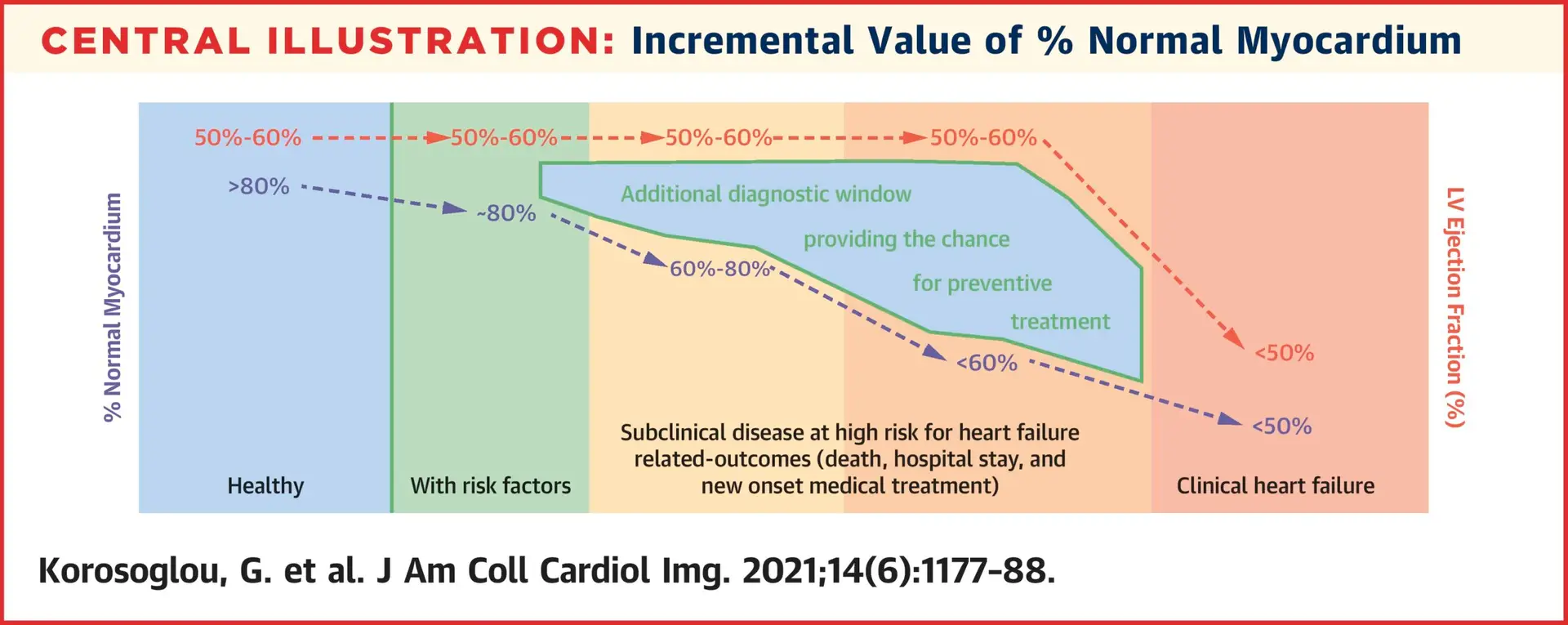
The heart is good at covering up problems. It finds ways to keep working even when it is damaged, so a person may feel fine and have normal test results for a long time. But underneath, the heart muscle may already be weakening. With the current standard test, the ejection fraction (EF), by the time a doctor spots the problem or a person starts feeling symptoms like shortness of breath, significant damage may have already occurred.1
MyoStrain®, using a technique called Fast-SENC, produces a MyoHealth® Score which is a single number showing how much of the heart muscle is working normally. Research has shown this can detect early, hidden heart problems in patients who feel fine and have normal standard test results, identifying people at risk of heart failure before serious damage occurs.2,3
- Packer M. J Am Coll Cardiol. 1992;20:248–254 and Sara JD, Toya T, Taher R, et al. European Cardiology Review. 2020;15:e13. (PMC7199190)
- Korosoglou, et al. “Fast Strain-Encoded Cardiac Magnetic Resonance for Diagnostic Classification and Risk Stratification of Heart Failure Patients.” JACC: Cardiovascular Imaging. 2021. DOI: 10.1016/j.jcmg.2020.10.024
- Hashemi et al. “CMR detects decreased myocardial deformation in asymptomatic patients at risk for heart failure.” Frontiers in Cardiovascular Medicine. 2023. (PMC9849678)

Quantifies Early Functional Changes
MyoHealth® Score quantifies segmental intramyocardial dysfunction across 48 segments, revealing early early heart muscle impairment.
Allows longitudinal monitoring
The MyoHealth® Score allows physicians to monitor disease progression, therapy and interventions response or lifestyle and traditional risk factors modification.
April 5, 2021
Journal of Cardiovascular Magnetic Resonance
The study compared MyoStrain’s ability to quantify and differentiate asymptomatic patients based on their cardiac risk versus traditional ejection faction, reiterating the technology’s potential as a critical cardiac risk stratification tool enabling clinicians to identify at-risk patients early for individualized preventative treatment.
January 13, 2021
JACC Cardiovascular Imaging
This article demonstrates MyoStrain’s ability to identify patients with subclinical LV dysfunction and those at risk for heart failure-related outcomes compared with LVEF, providing an additional diagnostic window for prevention treatments.
August 8, 2019
Journal of Cardiovascular Magnetic Resonance
This abstract demonstrates the clinical application of MyoStrain as a tool to help quantify, monitor, and manage cardio-protection for oncology patients exhibiting cardiotoxicity.
January 11, 2024
Korosoglou, G. et al.
May 13, 2022
Pezel, T. et al.
July 12, 2021
Giusca, S. et al.
January 13, 2021
Korosoglou, G. et al.